

Choosing the best Down Flooring for 2026 starts with a simple question: where will it go, and what must it handle? A busy downstairs hallway faces muddy shoes, rolling bags, and daily wear. A basement may have different moisture concerns. The right floor depends on those real conditions, not just a showroom sample.
This guide compares popular choices, including luxury vinyl plank, porcelain tile, laminate, and engineered hardwood. Each has trade-offs. Vinyl is often practical around spills, while tile feels durable but can be hard and cold underfoot. Engineered hardwood brings natural character, yet its suitability depends on the product, subfloor, and moisture levels. No single winner. Check each manufacturer’s care and installation guidance before buying.
Small details can change the decision. A click-lock plank may sound hollow over an uneven subfloor. A textured surface can help disguise dust, though it may take more effort to clean. I would not call any option perfect, and price alone rarely tells the whole story. Underlayment, installation, repairs, and warranty terms matter too. Where possible, compare samples in the room’s actual light and ask a qualified flooring professional to assess the subfloor. This overview offers a practical starting point, not a substitute for product-specific advice. The best choice is the one that fits your household, budget, and room conditions—and still feels right after the first winter.
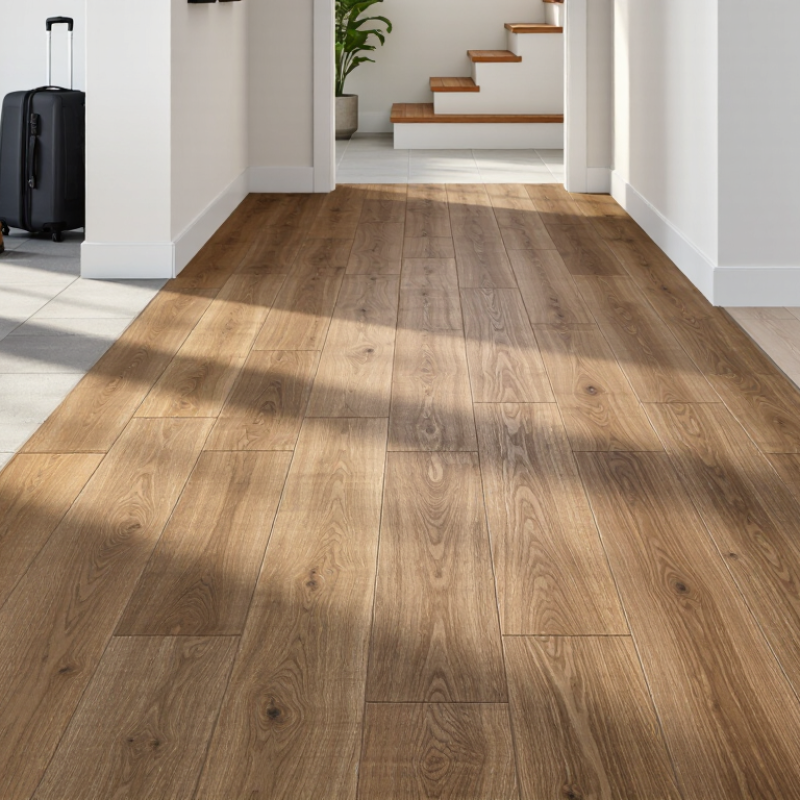
Downstairs flooring should be chosen by room conditions, not by one rule for the whole level. Basements are unforgiving. The U.S. EPA’s A Brief Guide to Mold, Moisture and Your Home advises drying wet materials within 24–48 hours to limit mold growth. That makes leak response as important as the flooring itself. On concrete, porcelain tile or properly installed resilient plank can handle routine dampness better than solid hardwood. But water-resistant does not mean flood-proof; moisture can pass through seams and collect underneath.
For laundry rooms and entry zones, prioritize cleanability, grip, and wear resistance. Mudrooms take hits. Sand and grit can scratch surfaces, so textured flooring and a walk-off mat help. FEMA’s National Flood Insurance Program estimates that one inch of floodwater can cause about $25,000 in damage. No flooring choice prevents that damage, so consider flood exposure before investing in a finish. Check the slab’s moisture level and the flooring’s installation requirements first.
Bedrooms and family rooms may suit warmer surfaces, but traffic matters. Dense carpet softens footsteps; engineered wood adds warmth but needs stable humidity and prompt spill cleanup. A showroom sample can mislead. Compare samples beside the stair landing, where daylight, shoes, and furniture meet. One material rarely suits every downstairs room, and moisture testing can feel like an annoying extra step. Skipping it may cost more.
AC3, AC4, and AC5 describe laminate flooring’s resistance to surface abrasion under EN 13329 testing. They are useful comparisons, but they do not measure every kind of wear. AC3 can suit many homes, especially bedrooms and quieter rooms. For a busy hallway, where grit gets tracked across the floor, AC4 offers a stronger abrasion class. AC5 is designed for heavier commercial use, though some households may prefer its added margin.
That distinction matters. A higher AC number does not automatically mean better protection from water, dents, or poor installation. Check the product’s use class and care instructions, too. A wet boot left beside a seam can cause trouble regardless of the abrasion rating. Not waterproof.
For many homes, AC4 is a practical middle ground; AC3 may be enough where foot traffic is light. AC5 can make sense in a busy household with pets, rolling chairs, or frequent visitors, but the extra rating may not solve every problem. Subfloor flatness, careful fitting, and entry mats matter in daily use. I would compare those details before paying more for a higher class. The rating is helpful, not the whole story.
ASTM F3261 and ANSI A137.1 describe different flooring categories, so they are not competing scores for the “best” floor. ASTM F3261 covers resilient flooring with a rigid polymeric core. It sets product requirements for features such as dimensions, surface characteristics, and performance. For a kitchen or entryway, that gives buyers a useful way to compare rigid-core products beyond color and plank width.
ANSI A137.1 applies to ceramic tile. It defines tile classifications and requirements, including properties such as water absorption and breaking strength. Check the tile’s classification and technical sheet before choosing it for a wet room or busy hallway. A glossy sample may look sturdy under showroom lights. It can still be slippery when damp.
Neither standard guarantees that a floor will suit every room. Subfloor flatness, moisture, installation materials, and workmanship affect the finished result. Read the cited edition and confirm that the product documentation matches the intended use. Ask how the surface handles spills, grit, and daily cleaning. Small details matter. I would not choose from a sample alone; standards help narrow options, but they cannot fully recreate a cold tile floor under bare feet or a noisy room after installation.
| Flooring type | Relevant standard | What the standard covers | Useful comparison data | What to check before choosing |
|---|---|---|---|---|
| Rigid-core modular resilient flooring | ASTM F3261 | A product specification for modular resilient flooring with a rigid polymeric core. Requirements depend on the applicable product classification and standard edition. | Compare declared product classification, thickness, dimensional information, and reported results for applicable physical-performance tests. | Ask for documentation identifying the ASTM F3261 edition and the classification or requirements the product claims to meet. The standard is not a single overall quality score. |
| Ceramic tile | ANSI A137.1 | A specification for ceramic tile, including requirements related to tile dimensions, surface quality, and physical properties. | Review the tile’s stated classification and applicable test results, including water absorption and strength-related properties. | Check that the product documentation identifies the relevant ANSI A137.1 edition and provides results appropriate to the intended installation. |
| Porcelain tile | ANSI A137.1; ASTM C373 for water-absorption testing | Porcelain is a ceramic-tile classification with water absorption of 0.5% or less, determined using the applicable test method. | Water absorption: ≤ 0.5% for the porcelain classification. | Low water absorption is one property; it does not by itself establish slip resistance, suitability for every location, or installation quality. |
| Vinyl and tile: use-area comparison | Use the applicable product standard and installation requirements | These standards specify product-related requirements; they do not select the best floor for a particular room or replace installation instructions. | Compare documented performance, intended-use guidance, maintenance needs, and compatibility with the subfloor and installation method. | For wet or frequently used areas, check the full product documentation and applicable safety, installation, and local building requirements. |
Note: Standards can be revised. Confirm the edition cited in the product documentation and verify the specific requirements that apply to the product and installation.
Choosing flooring for warmth and quiet takes more than judging a sample by touch. ASTM C518 measures thermal transmission under controlled laboratory conditions using a heat-flow meter. Its results can help compare flooring layers, but they do not guarantee a warm room. Subfloor material, installation gaps, moisture, and heating systems all affect comfort. A small sample may feel cozy in your hand, yet perform differently over a cold concrete slab. That matters. Ask for results tied to the tested material’s thickness and construction, rather than relying on broad claims about insulation.
For footstep noise, ASTM E492 measures impact sound transmission through a floor-ceiling assembly in a laboratory. A tapping machine creates repeated impacts, similar to hard-soled steps overhead. The test does not measure voices or outdoor traffic; those are airborne sounds. If a report includes an IIC rating, check the full assembly details, including the subfloor, ceiling, and underlayment. Ratings from different constructions may not be directly comparable. Not the whole story. Real rooms have furnishings, edges, and installation quirks that laboratory setups cannot fully reproduce, so test data should guide choices, not replace careful product and assembly review.
The best downstairs floor depends on what the space faces each day. Entryways collect grit, kitchens see spills, and lower levels may have damp air. Check the subfloor and moisture conditions before choosing a material. A sample can look convincing under store lighting but feel quite different at home.
Porcelain or ceramic tile handles heavy foot traffic and frequent cleaning, though it can feel hard and cold underfoot. Luxury vinyl is often comfortable, water-resistant, and relatively simple to maintain; its quality and repair options vary. Laminate can cost less, but standing water may damage some products. Engineered wood offers a warmer appearance than tile, yet still needs sensible moisture control.
Spills happen. Wipe them promptly, whatever the floor.
Compare the full installed cost, not just the price per square foot. Include underlayment, floor preparation, transitions, and any needed moisture testing. For a busy household, a textured, mid-tone surface may hide everyday dust better than a glossy, very dark one. That matters.
One easy mistake is choosing by appearance alone. Maintenance habits, pets, footwear, and room conditions all affect how well a floor performs over time. There is no perfect option; sometimes the practical choice is less attractive on a sample, and that trade-off deserves a second look.
| Cookie | Duration | Description |
|---|---|---|
| cookielawinfo-checkbox-analytics | 11 months | This cookie is set by GDPR Cookie Consent plugin. The cookie is used to store the user consent for the cookies in the category "Analytics". |
| cookielawinfo-checkbox-functional | 11 months | The cookie is set by GDPR cookie consent to record the user consent for the cookies in the category "Functional". |
| cookielawinfo-checkbox-necessary | 11 months | This cookie is set by GDPR Cookie Consent plugin. The cookies is used to store the user consent for the cookies in the category "Necessary". |
| cookielawinfo-checkbox-others | 11 months | This cookie is set by GDPR Cookie Consent plugin. The cookie is used to store the user consent for the cookies in the category "Other. |
| cookielawinfo-checkbox-performance | 11 months | This cookie is set by GDPR Cookie Consent plugin. The cookie is used to store the user consent for the cookies in the category "Performance". |
| viewed_cookie_policy | 11 months | The cookie is set by the GDPR Cookie Consent plugin and is used to store whether or not user has consented to the use of cookies. It does not store any personal data. |