How to Find a Professional Card Games Manufacturer
Choosing a Professional Card Games Manufacturer is not simply a search for the lowest quotation. It is a quality decision involving design interpretation, materials, printing, packaging, and delivery control. A strong factory should explain its card stock, coating options, color proofing, factory capacity, and inspection process clearly. Ask for physical samples, not only attractive digital images. Hold the cards under light. Check corner cuts, shuffle feel, surface friction, and box strength.
Industry data supports careful supplier selection. Kickstarter’s 2023 annual statistics showed that its Games category attracted more than 220 million dollars in pledges, demonstrating continued demand for new tabletop products. Grand View Research also identifies playing cards as a growing global product market, driven by entertainment, collectibles, and customized editions. These reports describe opportunity, but they do not guarantee manufacturing success. Market estimates can differ. That is worth remembering.
Richard Garfield, creator of Magic: The Gathering, said, “A game is a series of interesting choices.” His principle also applies to manufacturing choices. A supplier’s decision about linen finish, black-core paper, foil stamping, or carton thickness can influence the player’s experience. Request a documented pre-production sample and confirm tolerances before approving mass production. Review export experience, ethical labor practices, confidentiality procedures, and after-sales support. A low unit price may hide expensive reprints, delayed launches, or weak packaging. No supplier is perfect. Your first shortlist may still be wrong, so test it carefully before making a long-term commitment.
Define Your Card Game Manufacturing Requirements
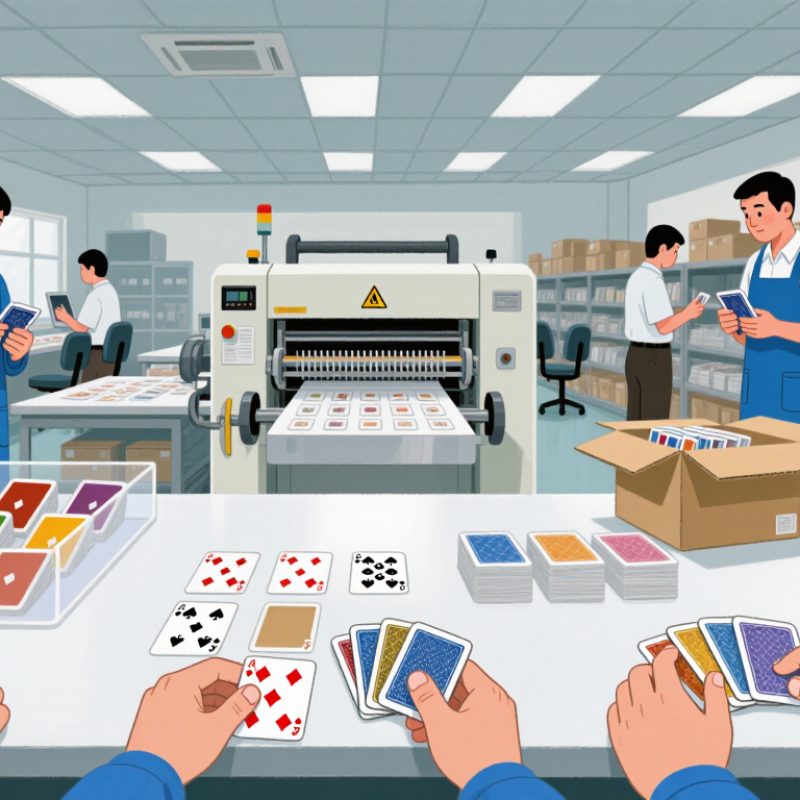
Before contacting a card games manufacturer, turn your idea into a measurable production brief. Specify the card count, finished dimensions, stock thickness, coating, corner radius, and packaging. A prototype with clear front-and-back artwork helps reveal issues that digital files may hide, such as tiny text near a cut line. State your target quantity and delivery window, too. These details shape tooling, setup costs, and the production schedule.
Set priorities, not just preferences. Decide which features are essential and where you can compromise: a linen-like finish may matter more than a rigid box. Ask for quotes at several quantities, and request samples made with comparable materials. Circana reported that U.S. toy sales fell 8% in 2023, highlighting why careful demand planning matters across the broader play market. It is not a forecast for your game, though. Treat early sales estimates as imperfect, and leave room to revise them.
Tips: Send a one-page specification sheet, print-ready files, and a physical reference sample if available. Ask the manufacturer to confirm tolerances, color-matching methods, proofing steps, and defect policies in writing. Small differences matter. A slightly slippery finish or a box that strains at the corners can change how a game feels after repeated use.
Research and Shortlist Qualified Manufacturers
Researching card game manufacturers requires more than comparing online photographs. Start with a clear product brief, including card size, paper thickness, coating, box style, quantity, and packaging needs. My first shortlist was too broad. I learned that attractive websites do not prove production capability.
Check each manufacturer’s factory experience, sample quality, and quality control process. Request physical samples, not only digital images. Examine corner cuts, color consistency, surface feel, shuffle performance, and box strength under normal handling. Ask how they manage proof approval, reprints, defects, and delivery delays. Small details matter.
Review certifications, business registration, factory photographs, and recent customer references where available. A qualified supplier should explain material choices and identify realistic production limits. Compare quotations carefully. A low unit price may exclude tooling, packaging, inspection, or shipping preparation. Ask about minimum order quantities and monthly capacity. Confirm whether the same team will handle sampling and mass production.
Keep written records of every specification. Communication gaps can create expensive mistakes. I would also arrange a video factory tour or an independent inspection when the order is important. This step may feel excessive, but it can reveal crowded workspaces, limited equipment, or unclear storage practices. No shortlist is perfect. Recheck it after receiving samples, because real evidence can change your judgment.
How to Find a Professional Card Games Manufacturer
Research and Shortlist Qualified Manufacturers
Common nominal poker and bridge card formats differ in width while sharing a typical 3.5-inch height. Use the required format to compare manufacturer capabilities, and confirm exact dimensions and tolerances with each supplier.
Evaluate Production Capabilities and Quality Standards
A professional card games manufacturer should prove its production capabilities with records, not polished photographs. Ask for machine lists, monthly capacity, material specifications, and recent quality reports. The ISO Survey 2022 recorded more than 1.2 million ISO 9001 certificates worldwide, showing how common certification has become. Certification helps, but it is not proof of excellent cards.
Inspect the complete production flow. Check paper caliper, coating uniformity, color consistency, corner cutting, and shuffle performance. A useful sample should include a printed sheet, a finished deck, and packaging from the same production batch. The manufacturer should measure color with calibrated instruments and document acceptable tolerances. Small differences matter. They can change how cards slide, stack, and feel.
Safety and traceability also deserve direct questions. Request ink and coating declarations, batch codes, inspection records, and a documented corrective-action process. For products intended for children, review applicable toy-safety testing and chemical limits in the target market. Independent testing is stronger than an internal promise. I would not rely on one successful sample; factories can prepare samples unusually well. Ask for random production samples and photograph defects under consistent lighting. The uncomfortable detail is often revealing: how the supplier handles misprints, warped cards, or late rework.
Compare Quotes, Minimum Orders, and Lead Times
How to Find a Professional Card Games Manufacturer
Compare Quotes, Minimum Orders, and Lead Times
A professional card games manufacturer should provide more than one attractive price. Ask for an itemized quote covering cards, packaging, proofing, tooling, shipping, and any setup fees. Compare identical specifications, including card size, paper weight, coating, box style, and insert materials. A lower quote may exclude essential costs. That mistake can become expensive later.
Minimum order quantities deserve careful attention. A factory may offer a competitive unit price at 5,000 decks, but your market may only support 1,000. Request prices for several quantities, such as 500, 1,000, 3,000, and 5,000 units. Check whether mixed designs require separate minimums. Also ask about sample charges and whether they become refundable after production. The details matter.
Lead times should be divided into clear stages. Confirm the schedule for digital proofing, physical samples, production, quality checks, and shipping. For a standard deck, production may take several weeks, but custom packaging can add more time. Ask what happens if artwork needs correction. Build a buffer for holidays, port delays, and approval changes. I still find schedules too optimistic when every decision is perfect. Real projects rarely are. Request a written timeline, inspection photos, and agreed tolerance standards before paying a deposit. A reliable supplier will answer specific questions without hiding behind vague promises.
Verify Samples, Contracts, and Ongoing Support
How to Find a Professional Card Games Manufacturer
A polished sample can hide serious production problems. Test several decks, not just one. Shuffle them repeatedly and inspect edge wear, card stiffness, corner cuts, and surface coating. Place the cards under bright light to check color consistency. Examine the box, insert, and wrapped packaging too. Small defects often appear at the edges first. Ask for revisions.
Request a written sample approval process. The contract should define card size, paper stock, finish, color tolerance, packaging, quantities, and delivery dates. It should also explain inspection standards, replacement terms, payment stages, and responsibility for damaged goods. Ambiguous wording creates expensive arguments later. A professional manufacturer welcomes precise questions and provides production proofs before printing. Keep records. I have seen projects delayed because verbal promises were never added to the agreement.
Ongoing support separates a capable supplier from a temporary printer. Confirm who handles artwork checks, proof corrections, shipping updates, and quality complaints. Ask how quickly support usually responds and what happens when a batch fails inspection. Request photographs during production, but do not treat photographs as complete evidence. A physical pre-production sample remains more dependable. Support matters. The relationship may continue through reorders, packaging changes, and unexpected stock shortages. No process is perfect, and my own reviews have occasionally missed minor alignment issues. Clear checkpoints make those mistakes easier to detect and correct.