How to Choose the Best Fitness Trampolines?
Choosing the right Fitness Trampolines takes more than comparing prices or counting springs. The best model should fit your body, room, routine, and comfort level. Dr. Kenneth H. Cooper, physician and founder of the Cooper Institute, is widely associated with this reminder: “We do not stop exercising because we grow old—we grow old because we stop exercising.” A rebounder can make regular movement feel inviting, but no piece of equipment guarantees lasting fitness.
Start with the details you can check. Measure the clear floor space, including room to step on and off safely. Look for a stable frame, secure mat attachment, and a weight rating that suits the intended user. Springs and elastic bands feel different underfoot; try both if possible. A quiet rebounder may matter in an upstairs apartment. So may a handlebar, though it should not replace balance or controlled movement. Small details count.
This guide compares size, bounce, construction, safety features, storage, and price. It also considers who may benefit from each style and which trade-offs deserve a closer look. A low-cost model might work for gentle sessions, yet feel unstable during faster moves. That distinction is easy to miss in product photos. I would not treat a higher price as proof of better quality, either. The right choice is the one you can use consistently, with enough space and control to move comfortably. Sometimes, the honest answer is to try a different model.
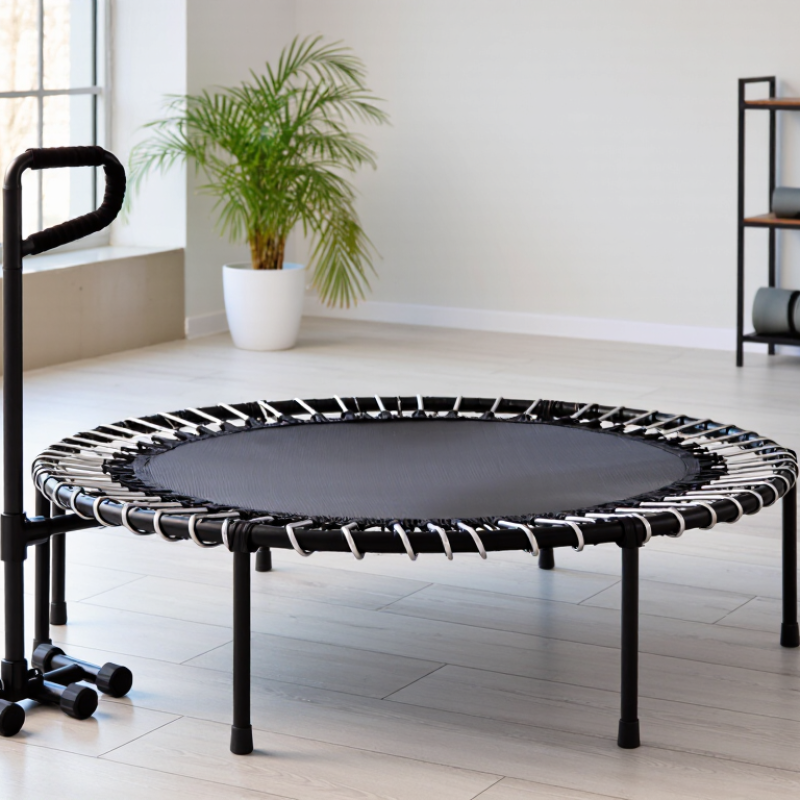
Define Your Fitness Goals and Available Space
Before comparing fitness trampolines, decide what you want them to help you do. A low-impact cardio session, short movement breaks, and balance practice call for different routines. The CDC recommends adults aim for at least 150 minutes of moderate-intensity aerobic activity each week. A trampoline can support that goal, but only if its bounce feels manageable and you use it consistently. Start with realistic sessions, such as ten minutes beside your usual workout space. Small steps count.
Measure the room before choosing a trampoline. Check the frame diameter, then leave clear floor space around it and enough ceiling height for comfortable arm movements. A compact model may fit beside a sofa, yet still feel cramped if nearby furniture blocks safe entry and exit. Measure twice. The ACSM’s 2025 Worldwide Fitness Trends survey kept exercise for weight loss among its top trends, a reminder that people often shop with a specific goal in mind. Match that goal to your available space: look for a stable, easy-to-store design if you plan brief sessions at home. I once underestimated how much room a simple arm reach needed. That was a useful, slightly annoying lesson.
How to Choose the Best Fitness Trampolines? — Define Your Fitness Goals and Available Space
| Fitness Goal | Suitable Trampoline Type | Typical Jumping-Surface Size | Suggested Clear Floor Area | Features to Look For | Space and Safety Considerations |
| Low-impact cardio and general fitness | Compact round rebounder | About 30–36 in (76–91 cm) across | At least 6 × 6 ft (1.8 × 1.8 m) | Stable frame, even bounce, nonslip feet, and a handlebar if extra balance support is useful | Allow roughly 2 ft (61 cm) of clear space around the frame; use on a level, nonslip floor. |
| Regular cardio sessions and varied movement | Standard round rebounder | About 36–40 in (91–102 cm) across | At least 7 × 7 ft (2.1 × 2.1 m) | Consistent rebound, durable frame, secure mat attachment, and a weight rating suited to the user | Check the assembled dimensions, not just the jumping surface. Keep the area free of furniture and hard-edged objects. |
| Balance, coordination, and controlled exercises | Rebounder with an adjustable support bar | About 36–40 in (91–102 cm) across | At least 7 × 7 ft (2.1 × 2.1 m) | A firmly secured, height-adjustable bar and a frame that stays stable during use | Include room to mount and dismount safely. The bar should not obstruct nearby walls or other users. |
| More room for lateral steps and wider movements | Large round rebounder | About 40–48 in (102–122 cm) across | At least 8 × 8 ft (2.4 × 2.4 m) | A larger usable mat, stable construction, and clear product guidance for the intended exercises | Measure doorways and storage space as well as the workout area; larger models may be harder to move and store. |
| Shared household use | Rebounder selected for the largest intended user and activity | Commonly 36–48 in (91–122 cm) across | Plan for the largest user’s movements; 8 × 8 ft (2.4 × 2.4 m) is a useful starting point for larger models | Clearly stated user-weight limit, sturdy construction, and an appropriate size for each user | Use one person at a time unless the manufacturer explicitly permits otherwise. Keep children supervised and follow the product instructions. |
Measuring tip: These are practical planning estimates, not universal safety standards. Confirm the trampoline’s assembled dimensions, user-weight limit, ceiling clearance, and safety instructions before purchase. Leave enough overhead clearance for the user’s full movement and avoid placing the trampoline near lamps, fans, or low ceilings.
Compare Trampoline Types and Sizes
Choosing the best fitness trampoline starts with matching its type to your workout space and training goals. A mini rebounder usually measures 36 to 48 inches across. It suits low-impact cardio, balance drills, and small rooms. A larger fitness trampoline offers more landing space but needs greater floor clearance. Spring-based models often feel firm and responsive. Bungee systems usually provide quieter, softer movement. Neither option fits everyone. Your joints, balance, and preferred workout rhythm matter more than appearance.
Size affects control. Beginners may feel safer on a wider surface, especially during side-to-side exercises. However, a compact rebounder can encourage better foot placement and posture. Measure the room, including ceiling height, before buying. Allow space around the frame. I once underestimated overhead clearance and had to shorten several movements. That mistake changed my view of “space-saving” equipment. A stable handlebar can help beginners, but advanced users may find it restrictive. Check weight capacity, frame stability, mat tension, and replacement-part availability. Reliable construction matters more than decorative features.
Tips: Stand at the center and extend both arms. Your hands should not approach nearby walls or furniture. Choose a surface that feels controlled, not overly springy. Test several minutes of gentle bouncing before intense training. Inspect the mat, legs, and cords regularly. Even experienced users can lose balance when fatigue changes their landing pattern.
Evaluate Frame, Mat, Springs, and Weight Capacity
How to Choose the Best Fitness Trampolines?
A stable frame is the foundation of a fitness trampoline. Look for thick steel tubing, even welds, and firmly attached legs. The frame should stay level when you shift your weight. I once chose a lighter model because it was easier to move. It wobbled during side steps. That mistake changed my buying habits. Check the frame’s finish for exposed metal, chipped coating, or early rust. Measure twice.
The mat should feel tight, but not rigid. Inspect the stitching around its edge, where repeated jumping creates stress. A durable mat usually has tightly woven material and reinforced seams. Springs also deserve close attention. They should stretch evenly and return smoothly without sharp squeaking. Coated or corrosion-resistant springs may perform better in humid rooms. However, spring count alone does not prove quality. The spring length, tension, and connection points also affect bounce control. Do not guess.
Weight capacity must include the user, clothing, and movement force. A person weighing 180 pounds should not select a trampoline rated for exactly 180 pounds. Leave a practical safety margin. Look for clear load-testing information, not vague claims. The surrounding floor should provide enough clearance for balance recovery. Before each session, inspect the mat, springs, and leg connections. Small defects can become obvious problems later. I still recheck these parts, even when the equipment looks fine. Fitness equipment is rarely maintenance-free.
How to Choose a Fitness Trampoline
Compare frame construction, mat material, spring or bungee design, and the stated user-weight limit. The chart shows illustrative capacity ranges often found across compact rebounder sizes—not industry standards. Always confirm the exact specifications with the product manufacturer.
What to look for: Choose a stated weight capacity comfortably above the user’s weight. Check that the frame feels sturdy, the mat is securely attached, and springs or bungees are evenly fitted and in good condition.
Check Safety Features and Assembly Requirements
A fitness trampoline should feel stable before you begin exercising. Check that its frame sits evenly on a firm, level floor and does not rock when you press down. Look for a clearly stated user-weight limit, a tightly fitted jumping mat, and covered springs or elastic cords. If the model includes a handlebar, make sure its height adjusts securely and its clamps do not shift under pressure. An enclosure may help limit accidental falls, but it does not replace careful use or supervision.
Assembly matters, too. Read the full instructions before opening the hardware bags, and compare each part with the parts list. Some frames need two people to tension the mat safely; forcing a spring into place can cause it to slip. Set aside enough room to work, keep small fittings away from children, and tighten fasteners as directed. After assembly, press around the mat and check for loose legs, gaps, or unusual movement. I once assumed a nearly aligned bolt was secure. It wasn’t a useful shortcut.
Tips: Keep the manual nearby, use the supplied tools, and recheck connections after the first few sessions. Stop using the trampoline if a cord frays, a weld looks cracked, or the frame shifts.
Compare Prices, Warranties, and Maintenance Needs
Choosing a fitness trampoline requires more than comparing the lowest checkout price. Grand View Research valued the global fitness equipment market at approximately $13.8 billion in 2022, showing strong consumer demand. However, market growth does not guarantee durable construction or fair warranty terms.
Recent retail comparisons place entry-level rebounders near $80–$180, while reinforced models often cost $250–$600. Check what that price includes. A longer warranty may cover the steel frame but exclude springs, mats, stitching, or labor. Read the exclusions.
A useful warranty should state replacement procedures, shipping responsibility, and whether residential use is required.
The International Health, Racquet & Sportsclub Association reported about 184 million health club members worldwide in 2022, but home equipment receives less routine inspection than club equipment. That difference matters.
Maintenance needs should influence the total cost. Inspect the jumping mat before every session, tighten visible fasteners monthly, and keep the trampoline away from sunlight and moisture. Replace stretched springs or cracked padding promptly.
ASTM F381 provides safety guidance for consumer trampolines, but compliance is not proof of lifetime durability.
My first shortlist focused too heavily on price. That was a mistake. I now compare replacement-part prices, service response times, and warranty length together. Some cheaper models become expensive after one worn mat. Reports provide useful context, but real ownership still exposes gaps.