

Top Stainless Steel Pipe Manufacturers in China
China has become a major sourcing base for stainless steel pipes across construction, energy, food processing, and industrial manufacturing. Choosing a reliable Stainless Steel Pipe Manufacturer requires more than comparing prices or browsing polished websites. Buyers need evidence from production floors, inspection records, and customer applications.
This guide examines leading Chinese manufacturers through practical criteria. These include material traceability, welding control, dimensional accuracy, surface finishing, and delivery consistency. We also consider manufacturing capacity, export experience, and responses to technical questions. A strong supplier should explain whether it uses 304, 316L, 321, or other grades for specific service conditions. It should also provide mill certificates, chemical analysis, hydrostatic testing, and relevant quality documentation.
Factory details matter. Look for automated forming lines, clean storage areas, calibrated testing equipment, and clear batch labels. Claims need proof. Certifications alone cannot reveal every production weakness, especially when inspection practices differ between factories. No supplier is perfect. A manufacturer may offer excellent polishing but limited customization, or competitive pricing with longer lead times. That trade-off deserves honest attention.
The companies discussed here are selected for their visible capabilities, technical communication, and suitability for international projects. Their performance should still be verified through samples, third-party inspections, and written specifications. This approach helps buyers reduce uncertainty before placing large orders. It also supports safer, more consistent purchasing decisions in a competitive market.
China’s Stainless Steel Pipe Manufacturing Landscape
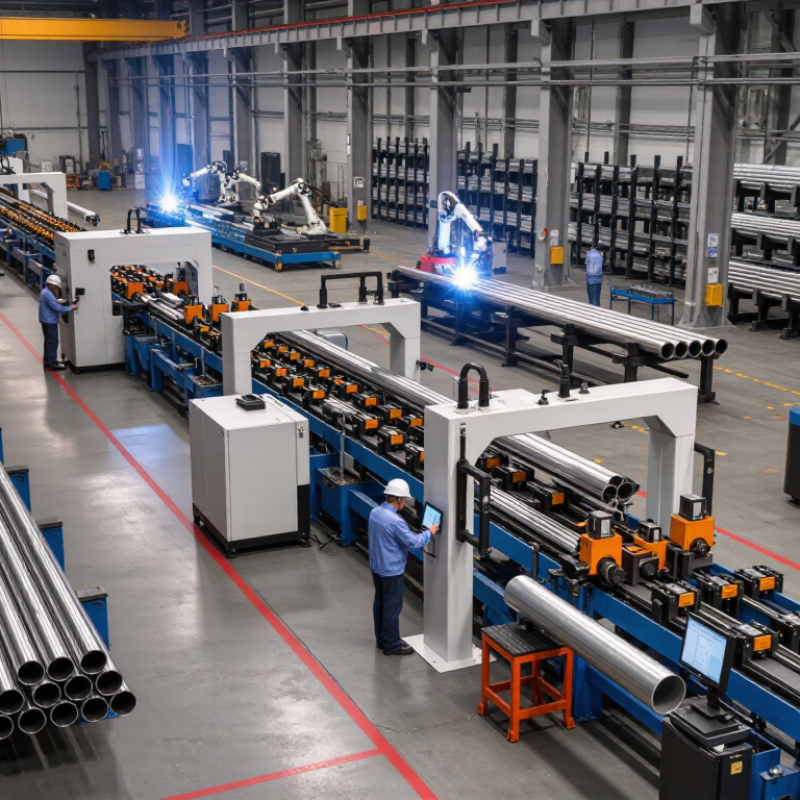
China’s stainless steel pipe manufacturing landscape is broad, fast-moving, and highly regional. According to the International Stainless Steel Forum’s 2023 statistics, China produced about 36.7 million tonnes of stainless crude steel. That volume represented roughly 63% of global output. This large base supports extensive pipe capacity, from welded tubes to seamless products.
Manufacturers often cluster near steel mills, ports, and engineering markets. Coastal facilities may offer shorter export routes and stronger inspection resources. Inland plants can provide cost advantages, but logistics require closer checking. Production quality depends on melting control, welding stability, heat treatment, and surface finishing. Practical audits should review ASTM or EN compliance, positive material identification, hydrostatic testing, and traceability records. A certificate alone is not enough. Site evidence matters.
Tips: Compare actual monthly capacity, not advertised capacity. Request recent mill certificates, sample inspection reports, and dimensional records. Check whether the supplier controls critical processes internally. Also examine packaging details, especially for long-distance shipping. ISSF data provides useful market context, but it does not prove one factory’s reliability. Buyers should remain cautious because capacity figures can change quickly. Even experienced purchasers sometimes overvalue polished facilities and undervalue process discipline. That is a mistake worth reconsidering.
Top Stainless Steel Pipe Manufacturers in China - China’s Stainless Steel Pipe Manufacturing Landscape
Landscape overview by manufacturer capability and product segment. Profiles below describe common industry segments, not individual companies or a ranked list.
| Manufacturer Segment | Typical Production Route | Common Product Forms and Grades | Relevant Standards | Typical End Uses | Quality Checks Specified by Standard or Order |
|---|---|---|---|---|---|
| Welded pipe producers for fluid transport | Formed stainless steel strip or plate joined by welding; finishing and heat treatment depend on product requirements. | Welded pipe in a range of diameters and wall thicknesses; common austenitic grades include 304/304L and 316/316L. | GB/T 12771; ASTM A312/A312M may apply to welded pipe meeting its scope. | Water and process-fluid systems, food processing, chemical equipment, and general industrial piping. | Depending on the specification: dimensions, visual and surface examination, mechanical tests, and specified nondestructive or leak testing. |
| Seamless stainless steel pipe producers | Hot working and/or cold finishing of a solid billet, followed by finishing operations appropriate to the required size and condition. | Seamless pipe and tubing; common grades include 304/304L and 316/316L, with other grades available to order. | GB/T 14976; ASTM A312/A312M covers seamless stainless steel pipe within its scope. | Industrial piping, pressure-related services, heat-exchanger systems, and applications requiring seamless construction. | Testing is specification- and order-dependent; may include dimensional inspection, tensile testing, hardness checks, and hydrostatic or nondestructive examination. |
| Large-diameter welded pipe producers | Plate forming followed by longitudinal or spiral welding, with inspection and finishing determined by the product specification. | Large-diameter welded pipe; grade and thickness availability depend on mill equipment and the order. | ASTM A358/A358M covers electric-fusion-welded austenitic chromium-nickel alloy steel pipe; project specifications may add requirements. | Industrial fluid lines, structural applications, and large-bore process systems. | Specified checks can include weld examination, dimensional inspection, mechanical testing, and pressure or leak testing. |
| Precision stainless steel tube producers | Cold drawing or cold rolling, often using a welded or seamless starting tube, followed by sizing and surface finishing. | Precision tubes with controlled dimensions and surface condition; austenitic grades such as 304/304L and 316/316L are commonly used. | Applicable requirements depend on product type and destination market; EN 10217-7 covers welded stainless steel tubes for pressure purposes. | Instrumentation, heat exchangers, automotive components, machinery, and other applications requiring tighter dimensional control. | Order-dependent checks may include outside diameter, wall thickness, straightness, surface finish, mechanical properties, and leak integrity. |
| Duplex and special-alloy pipe producers | Welded or seamless production, with processing and heat treatment selected for the alloy and required corrosion properties. | Duplex grades such as 2205 and selected higher-alloy stainless steels may be offered; availability is mill- and order-specific. | Relevant ASTM, GB/T, or EN product standards depend on alloy, manufacturing route, product form, and service requirements. | Chemical processing, marine environments, desalination, and services where strength or corrosion resistance requirements are elevated. | May include chemical composition verification, mechanical testing, corrosion-related tests, heat-treatment records, and weld examination when specified. |
Standards and grades are examples, not a claim that every producer or product complies with them. Confirm the applicable edition, product scope, dimensions, grade, testing, and certification requirements with the supplier for each order.