China Top 10 Modern Bridal Dresses Manufacturers?
China’s bridal manufacturing sector is moving beyond traditional satin gowns and heavy embellishment. Modern Bridal Dresses now combine clean tailoring, lightweight fabrics, detachable sleeves, and subtle three-dimensional details. These changes reflect a bride who may want one dress for the ceremony and another silhouette for the reception.
The Business Research Company’s Wedding Dresses Global Market Report 2024 describes continued market expansion, supported by online retail, personalized design, and rising wedding expenditure. Grand View Research also identifies customization and premium materials as important drivers in the broader bridal wear market. These reports provide useful direction, but their figures cover different regions and product definitions. Direct comparison can therefore be misleading.
Vera Wang, one of the world’s most influential bridal designers, once said, “I wanted to be a bride, but I didn’t want to look like a bride.” That idea remains highly relevant when evaluating Chinese manufacturers. A strong supplier should translate modern references into consistent production, not merely copy runway images. Look for evidence such as fabric testing, pattern-development capability, transparent lead times, and documented quality inspections. Small details matter: clean seams, secure boning, even lace placement, and packaging that protects delicate beadwork.
This guide examines ten China-based manufacturers through design capability, factory experience, customization, export readiness, and communication quality. No ranking is flawless. Supplier websites may show their best samples, while production reality can differ. Buyers should request current samples, verify certifications, and inspect workmanship before placing substantial orders. The most attractive dress is not always the safest purchase. Reliability still wears well.
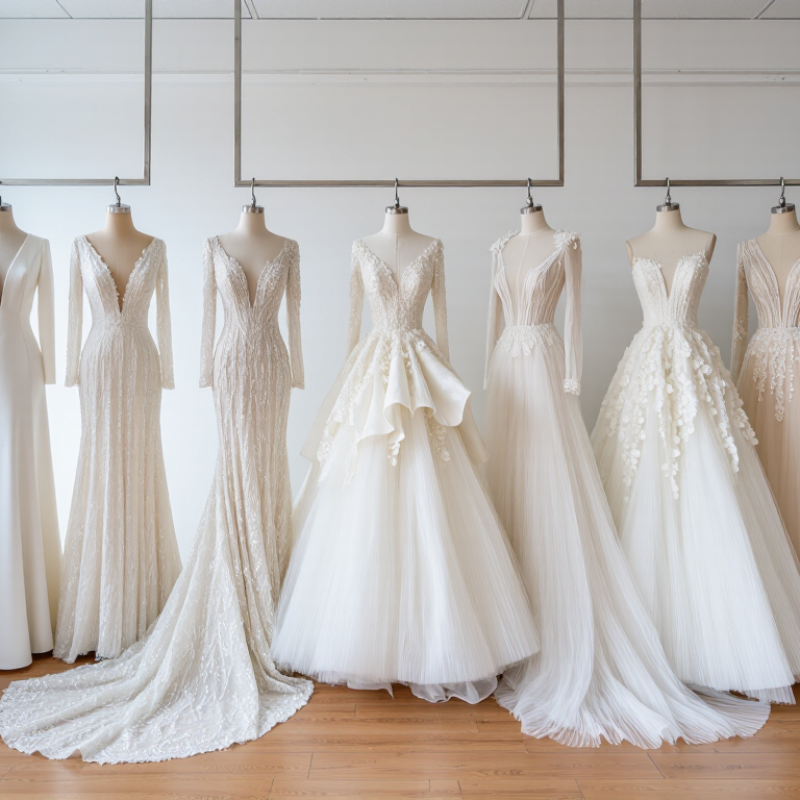
What Defines a Modern Bridal Dress Manufacturer in China?
A modern bridal dress manufacturer in China is more than a factory with sewing capacity. It combines pattern engineering, material control, responsive sampling, and dependable communication. According to The Knot’s 2024 Real Weddings Study, couples in the United States spent about $2,100 on average for a wedding dress. This benchmark increases pressure on manufacturers to deliver refined details without excessive waste.
Precision starts with the sample room. A capable team checks bust balance, corset tension, hem movement, and bead security through repeated fittings. Digital pattern systems can reduce cutting errors, but technology cannot replace an experienced technician. Small mistakes remain expensive. Manufacturers should provide clear tech packs, graded size charts, production photographs, and measurable inspection records.
Material responsibility also defines modern production. Textile Exchange’s Materials Market Report 2024 states that polyester represented approximately 57% of global fiber output in 2023. The report also shows rising recycled-polyester use, although traceability remains uneven. A reliable manufacturer should identify fabric composition, testing methods, and certification status instead of using vague “eco” language. Factory audits, worker-safety documentation, and shipment-level quality checks strengthen credibility. Still, no supplier is perfect. Sampling may reveal poor drape, inconsistent lace placement, or delayed corrections. Honest manufacturers record these failures and improve the process before bulk production.
Key Production Regions and Manufacturing Strengths
China Top 10 Modern Bridal Dresses Manufacturers?
China’s bridal production is concentrated in several complementary regions, not one single city. Suzhou is known for silk heritage, fine embroidery, and skilled hand finishing. Workshops there often suit dresses requiring delicate appliqué, beading, or layered tulle. The detail can be beautiful. It can also slow delivery.
Guangzhou and nearby areas provide dense garment supply chains. Pattern makers, fabric traders, sample rooms, and packing teams operate within practical reach. This supports fast revisions for modern gowns, including clean satin silhouettes and detachable sleeves. Production teams can source lace, lining, boning, and closures more efficiently when suppliers are nearby. However, speed varies sharply between factories, so buyers should verify monthly capacity rather than trust a general promise.
Hangzhou and parts of Jiangsu add strength in fabric development, digital pattern work, and small-batch manufacturing. Some facilities combine computer cutting with manual pressing and final shaping. That balance helps control fabric waste while preserving a dress’s structure. During a supplier assessment, request a graded size set, a pre-production sample, and inspection records. Check seam strength, zipper movement, color consistency, and measurements after steaming. A simple AQL inspection may miss design problems. Fit testing remains essential. Manufacturers with transparent lead times, documented material sources, and clear correction procedures are usually safer partners. Yet no factory is perfect; even experienced teams may misjudge a new fabric until it is sewn and worn.
Top 10 Modern Bridal Dress Manufacturers in China
China’s modern bridal dress manufacturing sector combines dense textile networks with increasingly precise small-batch production. Grand View Research estimates the global bridal wear market reached about USD 61.1 billion in 2023, with continued growth expected through 2030. That demand is encouraging Chinese factories to improve pattern development, digital sampling, and export compliance.
The top 10 modern bridal dress manufacturers in China should be judged by measurable capabilities, not attractive catalogues. Strong candidates usually provide in-house design, three-dimensional pattern correction, lace placement, beadwork, and documented quality inspections. Production regions around Guangzhou, Suzhou, and Hangzhou offer different strengths, from flexible sampling to refined embroidery. A useful factory audit should check seam tension, corset support, lining comfort, and color consistency under daylight. Small details matter.
Not every large manufacturer deserves a top-ten position. That is worth admitting. Some factories show excellent photographs but limited evidence of stable capacity. Others produce beautiful samples yet struggle with grading across sizes. McKinsey’s State of Fashion research continues to highlight uncertainty in fashion demand, making flexible minimum order quantities increasingly valuable. Buyers should request recent production records, fabric test results, ethical labor documentation, and realistic lead times. A 2024 supplier assessment may still become outdated quickly. On-site verification remains the more reliable measure.
China Top 10 Modern Bridal Dress Manufacturers
Recommended evaluation weights for comparing modern bridal dress manufacturers in China
The chart presents a neutral supplier-evaluation framework rather than company rankings. The 100-point model prioritizes quality control, customization, production reliability, material access, hand finishing, and export readiness when assessing modern bridal dress manufacturers.
How to Compare Quality, Customization, and Pricing
China Top 10 Modern Bridal Dresses Manufacturers?
Comparing bridal dress manufacturers requires more than reviewing photos. Request a physical sample before placing a large order. Examine the stitching around the waist, zipper, hem, and neckline. Even spacing usually indicates better production control. Check whether the lining feels smooth against the skin. A beautiful outer fabric can still hide rough seams.
Customization should be measured in details. Ask whether the manufacturer can adjust bust, waist, train length, sleeve shape, and fabric weight. Confirm how many revisions the sample includes. Some factories accept changes but charge separately for every correction. Share a measurement chart, reference images, and a written specification sheet. This reduces misunderstandings between design teams. Still, written instructions are not perfect. A sketch may show the silhouette but miss the desired softness of the tulle.
Pricing needs a complete comparison. Request itemized quotes covering fabric, beading, pattern development, samples, packaging, and shipping. A low unit price may exclude essential services. Compare the minimum order quantity and production lead time too. Ask how quality inspections are recorded before shipment. Photos of finished pieces can help, but they are not enough evidence. A reliable manufacturer should explain defect handling, replacement terms, and payment stages clearly. Leave room for delays during peak wedding seasons. Real production is rarely as smooth as the original quotation suggests.
Tips for Choosing the Right Chinese Bridal Dress Supplier
Choosing a Chinese bridal dress supplier starts with evidence, not polished photos. Ask for business registration details, workshop images, production capacity, and recent export references. A video call can reveal cutting tables, pressing stations, and fabric storage. Look for orderly records, not only attractive gowns. This matters.
Request one paid sample before placing a bulk order. Check the zipper, lining, boning, hem, and bead security under bright light. Measure the sample against the approved measurement chart. Small errors become expensive alterations. Ask which fabrics are available, where they are sourced, and how color batches are controlled. A reliable supplier explains tolerances clearly. Vague promises worry me. I have learned that a low sample price can hide weak construction or slow revisions.
Use a written specification sheet with sketches, fabric codes, size rules, packaging details, and inspection points. Confirm the timeline in calendar dates, including sample approval and final inspection. Keep communication in one shared channel. Save every change. Before shipment, request detailed photos of seams, labels, cartons, and finished measurements. An independent inspection can help with larger orders. Do not choose only by price. Compare response speed, correction attitude, and sample consistency. Sometimes the best-looking sample is not the best supplier. It may have been prepared only for display. Ask for a second style. That extra step can expose uneven workmanship, though it adds time and cost.